AI is 2026's Honey Badger
The debate about AI is over. And somehow, unusually, everyone agrees.
Lauren Berkowitz · Apr 28, 2026
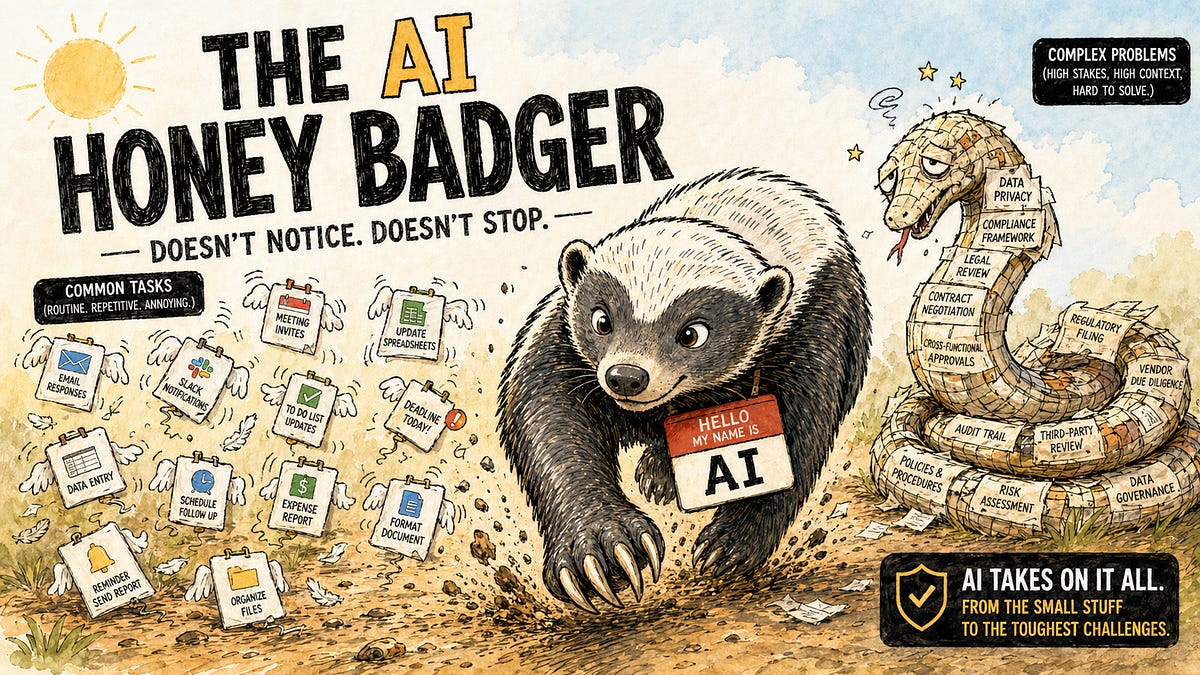
If you are not familiar with the honey badger, a brief introduction. It is a small, thick-skinned animal most famous for being impervious to threats and indifferent to inconvenience. It does not ignore danger. It registers the bee sting, the snake bite, the predator twice its size, and continues anyway. Nothing stops it, nothing slows it down, and it certainly does not wait for anyone to be ready.
Last weekend, reportedly over 700,000 people cleared three days of their lives for a free AI summit hosted by Tony Robbins. Three days, online, free, no HR department organized it, no training budget funded it. Millennials, Gen X, Boomers, people with full calendars and full-time jobs, showed up.
What struck me was the number in relation to the content of this summit, AI. Tony Robbins has been selling transformation for forty years, and his audience has always been the generation that supposedly resists change the hardest, the 45-and-older crowd who, the last time technology rewrote the workplace, had enough runway to absorb it gradually and without much visible panic. And here they were, in massive numbers, for an AI summit.
It is worth recalling how the last two technology shifts played out, because neither one looked anything like this. Manufacturing automation was real and painful. American manufacturing peaked at nearly 20 million jobs in the late 1970s and shed 7.5 million over the following four decades through a slow combination of automation, offshoring, and globalization. Blue collar workers bore the weight of it, but the damage accumulated across communities and decades rather than arriving as a single visible wave. The white collar digital transition was quieter still. Email and the internet arrived unevenly across industries through the 1990s and into the early 2000s, with real resistance along the way. Administrative roles did not disappear in a wave of layoffs but eroded through attrition, positions not backfilled, roles fading behind the people who left them. Jobs shifted more than they vanished, gradually enough that no single moment felt like a reckoning.
What both transitions had in common was time. Not because the technologies were less significant at that time, but because access was limited, adoption was uneven, and learning had real friction built into it. Getting ahead of either shift meant attending in-person training, flying to a seminar, buying a book, or waiting for a CD to arrive in the mail. That friction was not a bug. It was just how technology spread, and it bought everyone time That runway looks very different now. The summit comes to your laptop, costs nothing, and runs while you are still in your pajamas, and you can see in real time exactly who else is attending because they are posting about it. A generation ago you might have known someone doing Tony Robbins without knowing you knew them, but now you open your feed and your former colleague is on day one, your neighbor is sharing a framework she is already applying, and something that once felt like a personal choice starts to feel like a tide that you don't want to miss for fear of drowning or being left at sea. The combination of awareness, access and fear is why this time is so different, whether or not you believe that AI is bigger than anything that has come before.
And a similar experience is at the enterprise - The free dinners and sponsored summits and thought leadership events with top catering are the same signal in a corporate register, organizations running the same calculation individuals are running, just with a bigger budget and a PR team. What makes it more interesting is that many of these same organizations spent the last two years cutting travel and expense budgets, trimming offsites, tightening everything visible. That austerity seems to have quickly reversed itself the past 18 months. Five-star director retreats are back, offsite budgets are back, and the conference circuit is fuller than it has been in years, all happening inside organizations that announced layoffs in the same quarter. It is a strange simultaneity, and it tells you something about how uneven and uncoordinated the response actually is. Nobody is denying the storm. They are just not all experiencing it from the same room.
In nature, even lions eventually stop picking fights with honey badgers. Not because the honey badger made a compelling case for itself or won an argument, but because the nature of the thing becomes undeniable and at some point the energy required to keep challenging it stops making sense. Other animals recalibrate around it without announcing it, without holding a meeting about it. They just stop, and then they adjust.
What is striking about this moment is how fast that adjustment came. The 700,000 people at the summit, the packed dinner calendars, the employees reskilling on their own time without being asked, none of it was coordinated and none of it was slow. Nobody coordinated it. Nobody had to.
As for the honey badger? It's already moved on.
The honey badger in action, over 106M views: