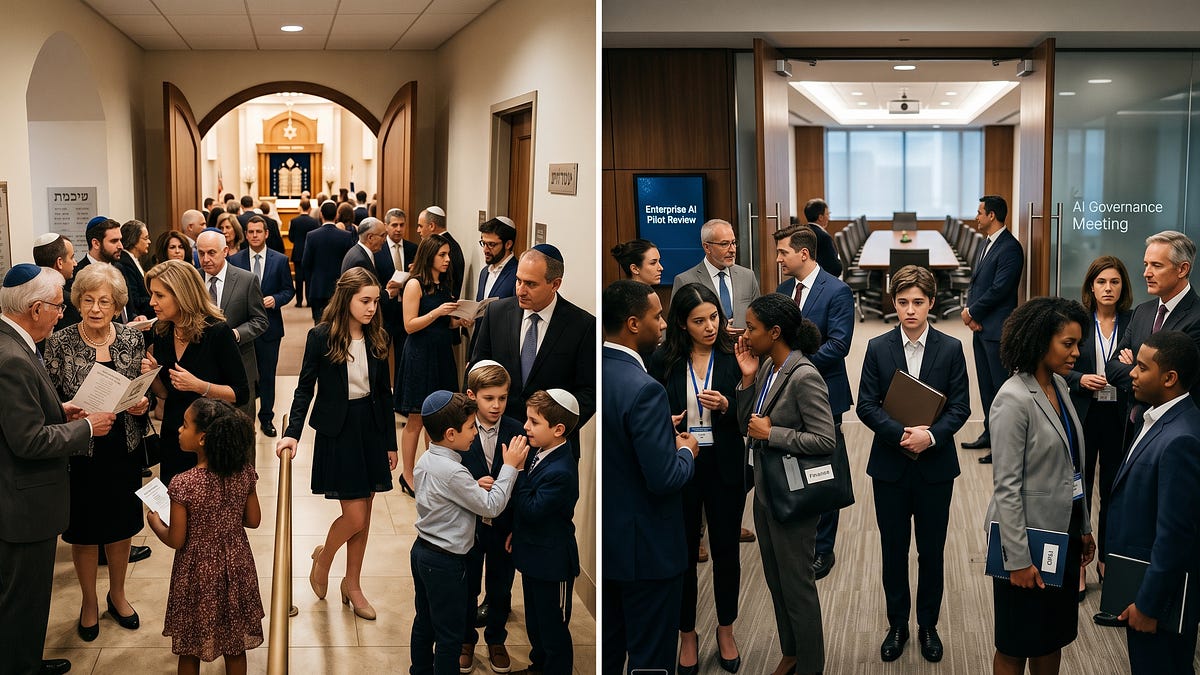
I went to a bar mitzvah this weekend, and, surprisingly, it made me think about enterprise AI.
Not the solemn part. Not the Torah portion. We are nowhere near that.
We are still in the earlier phase, when the synagogue doors open and everyone starts filing in. Girls wobbling in heels. Boys fake-fighting in the back. Adults trying to project calm. A few guests who know exactly what is happening. Others whispering, "Wait, what happens again?"
That felt uncomfortably familiar.
Because a bar mitzvah is a formal threshold into adulthood. The status changes in a moment, even if the maturity to carry it fully often arrives later. That is what makes it such a good analogy for what is happening with AI inside companies right now.
And like enterprise AI, a bar mitzvah pulls the whole ecosystem into the room at once. The grandparents who cannot quite hear what is going on but know it matters. The little kids darting around at the edges. The babies who have no idea why they are there. The handful of people who know the service cold and can find the right page in the prayer book without looking around. The many more who are following cues and hoping they stand up and sit down at the right times. The anxious adults trying to preserve order and significance at once. The guests glancing toward the sanctuary and asking what happens next. The central participant dressed for seriousness before the gait fully matches the outfit.
That is enterprise AI.
A few people understand the technology deeply. A few others understand the organizational stakes. Many are trying to infer both in real time. Some are overexcited. Some are skeptical. Some are afraid. Some are pretending to be fluent. Some are trying to keep things from catching fire. And a great many people are in the room because this has clearly become important, even if they could not explain the sequence of events from start to finish.
Which is why enterprise AI is no longer just a technology story. It is a full human systems event.
For the past two years, many companies have treated AI like something that could remain politely contained in pilots, labs, side experiments, and strategy decks with suspiciously polished language. That phase is over. AI is moving into workflows, budgets, approvals, hiring processes, customer interactions, planning cycles, code bases, and decision-making structures. It is entering more formal organizational life.
The expectations have risen. The shared readiness has not. That is where things get interesting.
Once AI enters the company for real, the question is no longer just whether the model can produce something useful. The question is whether the organization around it knows how to absorb what it changes.
That is when the adults start looking nervous.
IT wants governance, architecture, and security. HR wants trust, job redesign, and reskilling. Legal wants everyone to stop improvising. Finance wants measurable return. Business leaders want speed and advantage. The people closest to the technology see possibility. The people closest to the work see disruption. Senior leaders talk boldly about transformation while privately wondering how the operating model actually changes. Junior employees may adapt fastest while having the least authority to shape it. A few people know what they are doing. Many more are posturing. Several are just hoping to copy the right behavior from someone nearby and not get blamed later.
Again, bar mitzvah energy.
We are not yet at the bimah. In most companies, the rabbi has not even shown up yet.
We are still in the noisy pre-service phase, where the jackets are buttoned, the tallit is waiting, and seriousness is in the air, but structure is not fully in place. Different factions are already jostling over who gets control of the microphone. The people in charge are trying to make the moment feel meaningful and under control while quietly calculating all the ways it could go sideways.
And right now, only pockets of enterprise AI are truly dressed for the occasion. Some teams have real use cases, clear ownership, and enough governance to move without embarrassing themselves. Others have a license, a deck, and a rising sense of dread.
That unevenness is the story.
The real bottleneck is no longer just the model. It is whether the institution around it is mature enough to meet the moment. Whether leaders can tell the difference between ceremonial readiness and actual readiness. Whether companies can redesign work instead of stapling AI onto broken workflows and calling that innovation. Whether decision rights, accountability, and trust can evolve fast enough to match the seriousness of what is entering the room.
In that sense, enterprises are not simply evaluating AI. They are being evaluated by it.
So yes, I hope we are entering the bar mitzvah phase of enterprise AI.
Awkward as it may be, it would mean the transformation is at least becoming real. It would mean we are moving from novelty toward consequence, from experimentation toward responsibility, from theater toward a more serious threshold.
And if we are not even there yet, then the road ahead is likely longer and bumpier than most companies want to admit.
L'chaim. To the next phase.