I Wrote My First Book. It Rhymes. It Is About Germline Gene Mutations and the Future of Precision Medicine.
Lauren Berkowitz · Aug 5, 2026
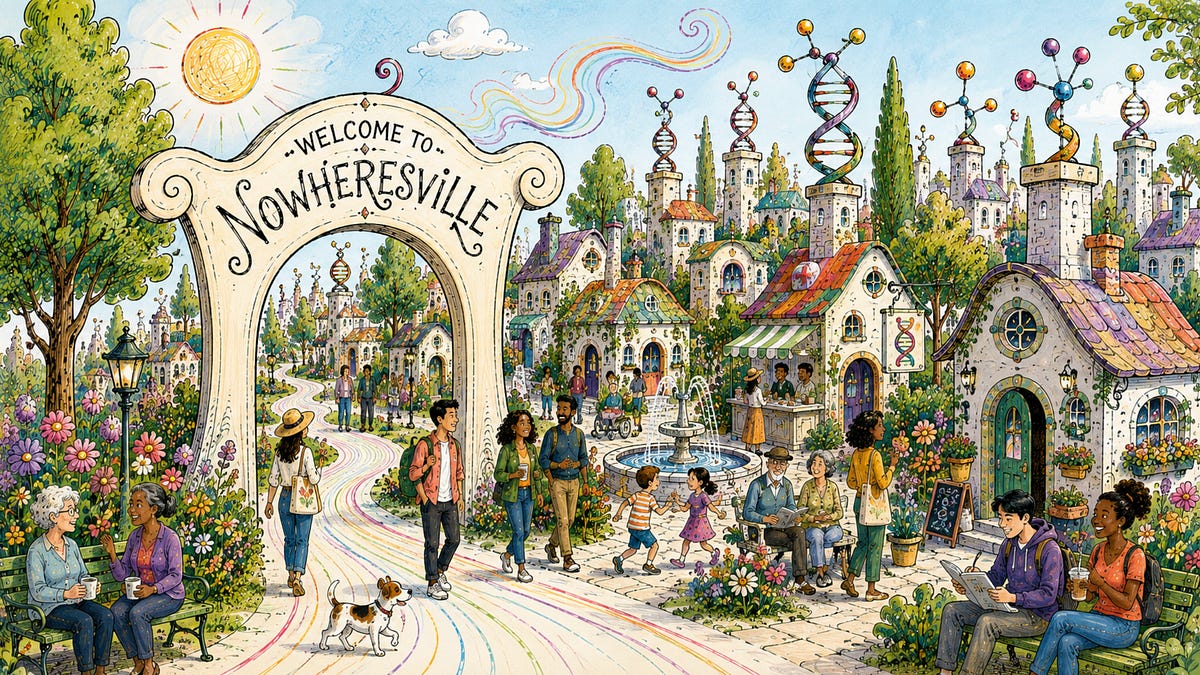
I wrote my first book over the past few weeks. It is not the book I intended to write. I did have another idea brewing for a number of years, as I imagine many of us do. I asked a former colleague, now a bestselling author, what he thought. Before even discussing the subject, he told me "nobody reads books anymore." He said to think hard about whether the idea had to be a book at all, or whether it could be an essay or a series. Then he described where book publishing sits now. Amazon takes in about ten thousand new ebooks a day, roughly triple the rate before ChatGPT, and a large share are now written with AI, some of them entirely. The book I intended is still to write, and I will revisit it under these guidelines in the future. The book I did not intend, the one that rhymes, is the one that had to exist, and it has to be a book.
I feel ok about it though, because I know the shelf it belongs on. It sits with Go the Fuck to Sleep and The Boy, the Mole, the Fox and the Horse, short and strange books that named a feeling a lot of people already had.
A few weeks ago, in a technology meeting, two genetic cancer doctors mentioned that a real need is modern patient tools to help patients understand and navigate serious genetic results. I'm not sure they were thinking a physical book, but it came to me anyway. I want to add to the incredible work that genetic counselors, patient advocates, educators, and volunteers do, not replace it.
I qualify as one of these patients. A test told me that I carry a BRCA1 gene mutation that raises my downstream cancer risks. Nothing is wrong yet, and nothing may ever be. I am well in most senses, and I have been handed a fairly detailed preview of one way I might stop being well, and I am asked to plan around the preview. I have spent years planning and executing around this preview, so I know the terrain.
I am also not unusual, and getting less so every day, at least in this regard: people who have been given serious genetic information about risks they have for downstream illness, conditions, or scenarios. So how many of us are there? A large American hospital system read the DNA of more than a hundred thousand of its own patients. About one in thirty was carrying a hidden risk. Interestingly, nine in ten of those had no idea. One in thirty is now the cautious count, limited to a short list of genes. A newer small study this year put it closer to one in eight. One in eight, most of them well, and unaware. I personally believe that in the next 18 to 24 months, that's where we will be, one in eight or below. I believe this number rises quickly because of AI acceleration, longevity investment, and the demand for precision medicine. Precision medicine is care built around your specific biology. It works by learning a great deal about one person in order to optimally guide and treat them. Included here is detailed genomic information, with many known and yet to be discovered pathogenic variants, both somatic (acquired over a lifetime) and germline (inherited from your parents).
The book gives the whole scattered group one address. It is a town you move into by receiving information that you are in this situation, where you are not sick yet but not exactly well, and it is called Nowheresville.
Welcome to Nowheresville. Come in. Take a seat. No one arrives here by choosing this street. You came by a letter, a phone call, a screen, a sentence that changed what your future might mean.
Why did I write it as a nursery rhyme for grown people? First, it kind of arrived on its own, as there is a lot of absurdity, like when Alice falls down the rabbit hole in Alice in Wonderland. The language here is inverted and some of it sounds invented. A positive result is bad news and a negative result is a relief. There is an official label, variant of uncertain significance, for a result that says something is there but cannot say whether it matters. You are visible and invisible at once. And the doctors themselves lose track. One of mine hugged me at an appointment and told me I looked wonderful, because he had not read my chart and assumed I had cancer. He forgot, which is understandable, as probably ninety-eight percent of his patients have cancer. But still, that is my doctor, and this has happened numerous times, actually, with different doctors and medical assistants.
Second, this is a serious subject, and bringing lightness to it by pointing out the absurdity, and being able to make it rhyme, made me, and I hope others, feel less alone with it. If you can laugh about something, you feel less alone and more like you can manage it. At least that is my hope. I would never want to trivialize someone's feelings or experience.
People in this scenario can be both lucky and lost. Most of them, I believe, feel lucky at some level - they know, and they have the option to intervene. Many first became aware of the scenario by watching someone in the family who was not lucky enough to receive the information before disease. So they know how fast well can end.
Lucky and lost at the same time. That is who the book is for, so they aren't lost and alone. Feeling seen and heard is important.
Finishing it surprised me. When I finished it and read it through, I burst into tears, not from sadness, but because everything I had learned in pieces was there. And I hoped I could hand it to someone else, the knowledge and the relief together, that it might make someone feel better, explain the oddness in a less scary way to someone new to the news, and help a parent explain to a child what is going on.
Go the Fuck to Sleep came out in 2011 and caught parenting exhaustion no one would say out loud. The Boy, the Mole, the Fox and the Horse came out in 2019 and became the book people found through the pandemic, a locked-down world that had gotten lonely. The moment now is millions of people being handed information about their own futures, with the opportunity to help them know what to do with that knowledge. The colleague who warned me may be right that most of what gets written now does not need to be a book, but I think this one does.
Sources: New ebook volume and AI share, Reimers and Waldfogel, National Bureau of Economic Research, working paper 34777, 2026. One in thirty, Geisinger MyCode, JAMA Network Open, March 2025. One in eight, Mayo Clinic PREDICT study of 484 healthy adults, Genetics in Medicine, May 2026. BRCA1 risk and the somatic versus germline distinction, National Cancer Institute. Go the Fuck to Sleep reached number one online before its 2011 release; The Boy, the Mole, the Fox and the Horse won the 2023 Academy Award for Best Animated Short.