My BRCA Poem Became an Eminem Song. Now What?
On AI music, who gets to make culture, and one very unlikely collaboration I'm hoping for.
Lauren Berkowitz · Apr 15, 2026
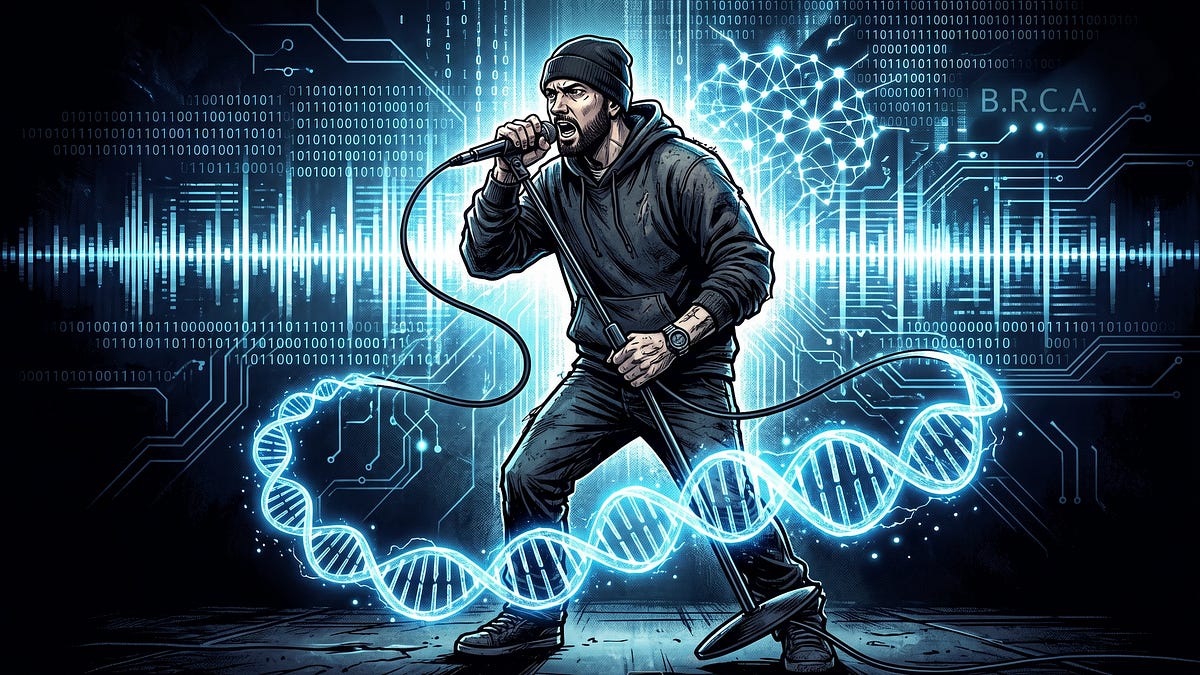
My father called me on a weekday evening a number of years ago. He had done 23andMe the way a lot of people do, curious about ancestry, about how Jewish we were... the ordinary reasons. There was no family history that would have put me on alert, no signal. He called, and what he told me changed the trajectory of my life.
I carry a BRCA1 mutation, a pathogenic gene variant that dramatically increases the likelihood of breast, ovarian, pancreatic, and prostate cancer. Many people learned it existed when Angelina Jolie wrote about it in 2013. Those of us who carry it learn about it the way I did: a phone call from a relative, an email from a testing service, a result that arrives without a doctor in the room because the technology got there before the infrastructure did. You find out, and then you figure out what to do with what you know.
I made my decisions. The surgeries were brutal. Years passed, and then, from a place of feeling stronger than I had in a long time, I sat down and wrote a poem.
Not to process the finding out, because I was past that. I wrote it because I wanted to mark having come through something, for myself. I write poems, and I do song parodies for my own amusement: a rewrite of Prince's "Purple Rain" during COVID called "COVID Pain," an "Imagine" parody about machine understanding. I know when something I've written works, and the poem was good. I knew it when I finished it.
What I did not know was what it would become.
I gave it to Suno with a simple prompt: make this a pop hip-hop anthem. You can't ask Suno to sound like a specific artist, that's not how it works, and I didn't try to cleverly ask it to sound like anyone. What came back was just... holy fuck, this was really good! I sent it to a handful of people, they called me immediately, wanted to know how I had done it. Some of them heard a resemblance right away. I heard the quality first, and the more I listened the more I heard it too, not just in the production but in the voice Suno chose for it, a voice I never specified, that sounds a lot like Eminem. (The link to the song and the poem appear the end of this article)
That was when I understood what the poem could be for, not just a personal milestone, but possibly an anthem for a community who yearns to hear what survival sounds like before they have survived themselves.
I've spent enough time in the music industry and enough time writing about AI to have some thoughts on what happened. I was an SVP at Sony and EMI, negotiating digital deals with Apple, Amazon, and Google when that was still a new thing to do. I'm a lawyer, and I write about AI and what it costs us humans at my Substack, Ctrl Alt Human. I'm not a music attorney and I'm not in anyone's boardroom, so what follows is analysis rather than inside information, but I've been around long enough to have a read on what's happening.
What AI Music Training Actually Does, And Doesn't Do
The instinct when you hear "Suno produced an Eminem-sounding track" is to assume it trained directly on his recordings and is essentially reproducing them at one step removed. My guess, reasoning backward from the output, is that what I fed it mattered more than any single artist's catalog. A look at how the poem moves:
A small code. A cold fact. A bold track. B. R. C. A. Say it plain. Not as a shadow, not as a chain, but as a name we can face without letting it take what it cannot claim.
Those are the defining characteristics of a whole ecosystem of hip-hop that Eminem both came from and shaped: staccato rhythm, internal rhyme, forward momentum, words that hit like percussion. Whether the model found him specifically or found the genre he dominates, I can't say. What I can say is that I didn't put him in, and he came out, which raises questions worth sitting with regardless of the technical explanation.
Those questions land in IP territory pretty quickly. Style is not copyrightable, and what's copyrightable is the specific fixed expression, the actual recording. Producing something that sounds like Eminem is legally different from reproducing "Lose Yourself," and I won't pretend to know exactly where that line lands, because nobody does yet. What I can say, from years of watching this industry fight over exactly these kinds of distinctions, is that the line has always been contested, long before AI had anything to do with it.
The Lawsuits, the Settlements, and What I Think Was Actually Going On
In June 2024, Universal Music Group, Sony, and Warner Music Group filed suit against Suno and its competitor Udio for mass copyright infringement, alleging both platforms trained on copyrighted recordings without authorization, and here is my take, offered as analysis rather than inside information.
Udio settled with UMG and Warner on terms that, from the outside, looked like a significant concession: users lost the ability to download their creations, and that single restriction appears to have effectively killed Udio's user base. The product became something people couldn't use the way they wanted to, and they left. Suno negotiated different terms with Warner, where downloads remain for paid subscribers, and the deal unlocks something I find more interesting than training rights: licensed experiences featuring Warner artists' voices, compositions, and likenesses as a product feature. Suno's litigation with UMG and Sony continues as of this writing.
This is a playbook I watched up close during my years in the music industry. The labels don't sue to stop, they sue to get to the table, and the Warner settlement suggests at least one answer to what that table looks like is forming.
The Product Nobody Has Fully Built Yet
When I started thinking through the Eminem problem, I had a hypothesis: there is probably a small number of massively influential artists whose styles account for a disproportionate share of what users actually want to create, such that licensing the top 100 would cover most of what matters. Do you really need all of Sony's catalog, or do you need the 40 artists in that catalog whose styles people are actually invoking?
The hypothesis feels right but the mechanism is different than I initially assumed. Most major artists don't own their masters, and Eminem doesn't own his Aftermath recordings, UMG does. Taylor Swift re-recorded her entire back catalog specifically because she didn't own hers. Going directly to an artist gets you their composition rights if they own their publishing, and their personal endorsement, but it does not get you the actual recordings. The private equity firms that have acquired major publishing catalogs hold songwriter royalties, not master recordings, so "skip the labels, go direct to artists" doesn't hold as a training strategy. The labels are still the efficient path to master rights.
But here is where the concentration idea finds its real footing, not in training but in product. The Warner deal gives Suno the ability to offer licensed, branded artist experiences as a feature, "create in the style of [Artist]" as an officially sanctioned, revenue-sharing partnership rather than an unlicensed approximation that lawyers will eventually come for. My instinct is that you could map 90% of user style intent globally to somewhere around 100 artists, which is not a full catalog license but a targeted partnership model where an artist's sonic identity is available as a feature, with their participation and compensation. That product doesn't fully exist yet, and the company that builds it changes who has leverage in ways the current legal framework hasn't caught up to.
I watched the music industry spend a decade being disrupted by companies that moved faster than the legal framework, and the artists who fared worst were the ones whose rights were entirely controlled by others. That dynamic is not going away, it's just operating at a different layer now.
What I Didn't Expect
Here is the thing I keep coming back to, separate from all of that.
I did not set out to make something remarkable. I wrote a poem I was proud of and wanted to see what it could become. I have done this kind of thing before: my "Purple Rain" rewrite during COVID called "COVID Pain" stayed on the page because there was no path to make it more, and my "Imagine" parody about machine understanding that the CEO of my AI company thought was good enough to have performed and recorded for company use, which took time, depended on finding the right person, and produced something that was okay. Both attempts had rate limiters. This one had none. I typed a prompt, and what came back surpassed either of them in the time it takes to finish a cup of coffee. That gap is the whole story.
That moment of being surprised by your own output is the thing worth paying attention to, not the legal framework, not the business model, not which platform wins.
This is why tools like Suno became popular so fast, not because people want to fake being musicians, but because people have always had things inside them that deserved to exist in the world, and the gap between the thing in their head and the thing they could actually make was too wide to cross alone. That gap just got a lot smaller, for a BRCA carrier writing a poem years after coming through something hard, for a grieving parent who wants to make something for a child, for anyone who ever had something to say and no infrastructure to say it through. The gatekeepers are not gone, but for the first time in the history of recorded music, they are optional.
The Dream
In my actual dream world, Eminem hears this song, likes it, maybe partly because it sounds like him, maybe because he's moved by the story, which is its own strange loop, and decides he wants to be part of it. We collaborate, and the BRCA community gets an anthem with real reach, made by someone who lived it and an artist whose voice carries it somewhere it couldn't go otherwise.
And I hope that if he ever heard it, the first feeling wouldn't be violation, but something closer to wonder. Because his influence is now exponential in a way that was never possible before, where one artist's lifetime of work becomes a reference point a model can find and surface in contexts he never imagined, for communities he never knew, in service of things he never planned for. A woman writes a poem years after coming through something hard, and the sonic fingerprint of everything he built is what the model reaches for to carry it, traveling somewhere no tour, no album cycle, no label strategy could have sent it. The upside of that is genuinely new. Yes, the corollary is real, that influence can be diluted, flattened, emptied of what made it matter, and both things are true. But the exponential reach in the other direction, intentional or not, deserves to be named.
My music industry connections are cold, and I'm not somebody with a million followers who can just tag him and have it land. The Warner deal points toward something like this, licensed artist experiences, voices, likenesses as features, but what I'm describing goes further. Not just "create in the style of Eminem" as a product feature, but a real bridge where an artist can see in real time how their influence is traveling, into what communities, in service of what causes, and choose to step in, not because a label arranged it, not because a publicist thought it was good for his brand, but because the technology made the connection visible and gave the artist a hand in what happened next. That's the version of this nobody has fully built yet, and if they did, this story has a different ending.
The thing in your head can exist now, and for the BRCA community, for anyone who has ever had something to say and no infrastructure to say it through, that changes everything. The gatekeepers are not gone, but for the first time in the history of recorded music, they are optional. That's new, and it matters way more than whatever the courts eventually decide. We've seen this before: when technology, human experience, and meaning collide, they find a way through.
The Lantern
by Lauren Berkowitz