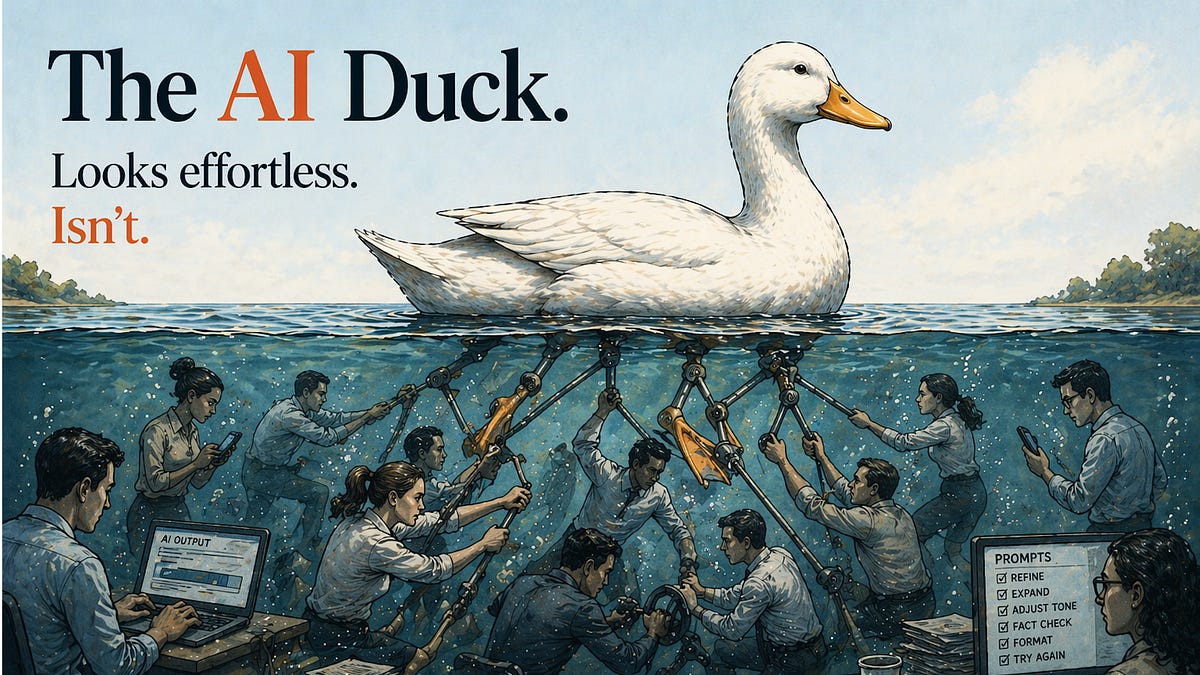
Lately, AI has started to resemble a duck on water. On the surface, it looks smooth, elegant, effortless. Underneath, there is frantic motion. Somewhere below, a lot of humans are paddling furiously so the whole thing can keep moving and still look effortless.
I keep seeing some version of the same AI success story: the founder or CEO with the four-hour workweek, who now has time to be with family, take a week's vacation every month, study ancient philosophy, casually pick up Italian, get healthier, think bigger. And some of that does seem true. There appears to be no shortage of C-suite travel, speaking, and beautifully packaged ideas about what all this is unlocking.
What seems less true, at least for now, is that this is a shared experience across the enterprise.
Beneath the C-suite, a different reality is taking shape. Teams are prompting, reviewing, checking, refining, and stitching outputs together to get from impressive to actually usable. And that work is increasingly falling to a new class of employee inside the enterprise: people with real subject matter expertise and real AI fluency. They know the domain well enough to spot what is wrong, and they know the tools well enough to push the output closer to right. They are the ones closing the gap between what the machine can produce and what the business can actually use. For now, that combination is becoming an extremely valuable form of labor.
Ironically, what makes the gap even more visible is that some tools now surface a metric for all of this: time saved. The product tells you that you have saved hours, sometimes down to the decimal. And if you have really saved those hours, you should feel them. Many people do not seem to, because whatever the tool is measuring, the human is still living everything after the first pass: checking, fixing, recovering context, hunting for the right version, repairing the logic. A lot of the "time saved" story seems to capture the easy part, the first draft, the first acceleration, the thing that looks finished. In enterprise settings, that is not the same thing as being ready. Ready means accurate, aligned, usable downstream, able to survive scrutiny, able to scale.
And in enterprises, that friction compounds. You are not just trying to make the work right. You are trying to make it right while navigating organizational disorder at the same time: multiple stakeholders, shifting versions, unclear ownership, broken handoffs, uneven adoption, and different teams all using different tools in different ways with different assumptions about what "done" even means. The last mile is not just refinement. It is refinement plus coordination, refinement plus interpretation, refinement plus organizational drag.
Not every company is equally stuck. Some are farther along. Some are standardizing tools, redesigning workflows, and reducing the chaos. But in many organizations, AI has arrived before the operating model has. Which means a surprising amount of what looks like AI fluency is still human improvisation in nicer packaging.
None of that makes this moment any less exciting. Quite the opposite. The value is so real that people are willing to work through the mess. I have seen a version of this before. In the early digital music era, plenty of people underestimated how much effort ordinary consumers would put in if the payoff felt big enough. They assumed people were too lazy to rip CDs, upload songs, organize libraries, and change their behavior at scale. They were wrong. People worked very hard to enter a new world once they believed the return was worth it.
AI feels similar. The payoff is big enough that people are willing to work through the friction. The difference is that, for now, the friction and the upside are not yet being experienced equally.
At the same time, a new, highly valuable class of enterprise employee is emerging in real time: people who combine subject matter expertise with AI fluency and know how to turn promising output into something the business can actually use. Much of the real value seems to be getting created there, beneath the cleaner story on top. Right now, the AI story still glides a little too smoothly over the humans paddling underneath it..