The Biggest Evolution of Our Generation Has No Name
The last shift changed what we do. This one changes what we are.
Lauren Berkowitz · Jun 9, 2026
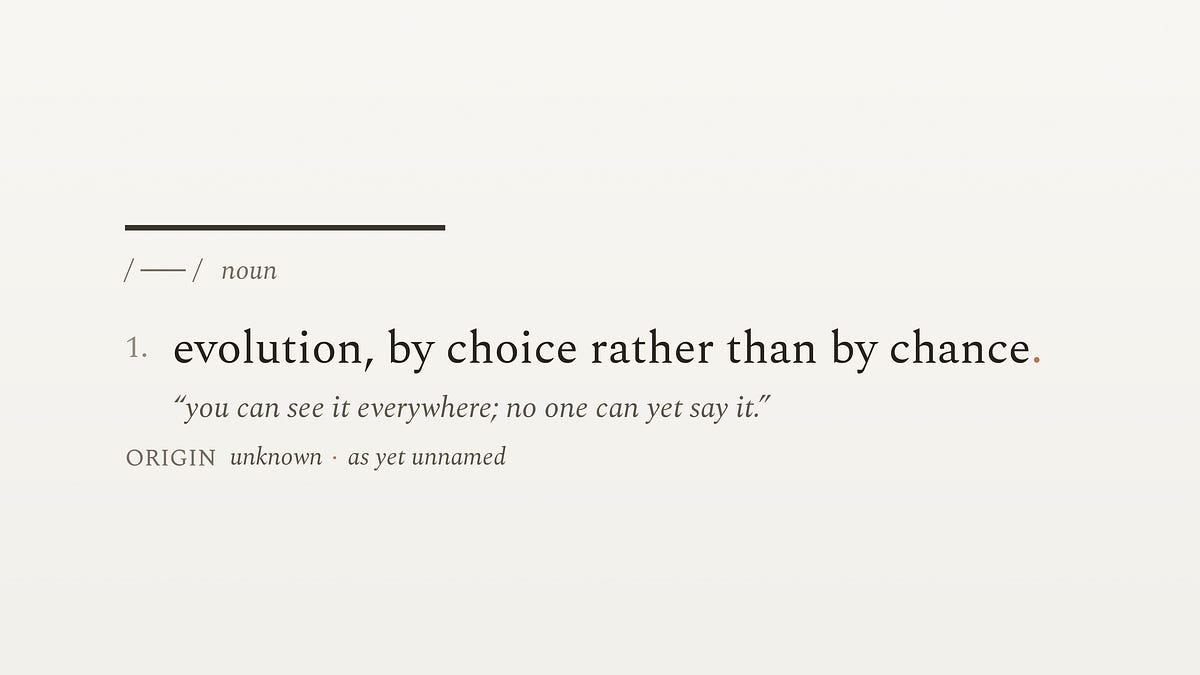
By the time a thing has an obvious name, the people who saw it early are already inside. Before the name, it is a scatter of unconnected stories that only a few read as one. Right now there is a scatter like that on the page: a genome that reads for about a hundred dollars, a fund raising billions to reverse aging, a company selling the DNA of millions in bankruptcy court, a country preparing to sequence every newborn. They are filed as separate stories, but they are plainly one thing, and it still has no name.
What pulled them together is two collapses at once. The price of reading a genome has fallen by a factor of tens of millions in twenty years, and the cost of the AI that can make sense of that much biology keeps dropping by an order of magnitude a year. When the data and the means to read it both get cheap at once, fields that used to advance on separate tracks begin advancing on the same one.
What feels different now is that the promises are producing receipts. I wrote last week about the longevity superhighway finally opening, and this is the wider landscape that highway runs through. Altos Labs launched in 2022 with three billion dollars behind it, the largest opening in the history of biotech, to reset the age of cells, and the odds of winning an NCI grant have fallen from about one in ten to one in twenty-five even as private capital pours into the same science.
The absence of a name is not a small thing, and the trouble is too many names, not too few. Genomics is the reading of the code, longevity the lengthening of the run, precision medicine the treatment fitted to the person, wellness the consumer version, with biotech, digital health, and techbio each covering some of the ground and missing the rest. They overlap, which is the problem, because a name built from crossing parts works like a name spelled out letter by letter. LGBTQ is the familiar example, a label built by listing, where the list becomes a running argument over who is in, and which on its own tells you nothing about what it means unless you already know the letters. The pile of partial words for this convergence sits in the same unstable place.
The same trouble reaches all the way down to the individual, the version I have written about here more than once. Someone learns they are walking around with a pathogenic variant, a mutation that raises the odds of a disease that has not arrived, and finds there is no settled word for what they now are. Carrier sounds contagious, previvor had to be coined because the language had no slot for a person who is neither sick nor safe, and patient is simply wrong, since there is nothing yet to treat.
And it reaches all the way up, to the one big word that ought to cover the whole thing. Evolution is the obvious candidate, since a species turning into something else is exactly what is happening, but the word already belongs to the slow, blind process that grinds on a population over ages, by chance, with no one choosing it. What is underway now is the reverse, a species reading and rewriting what it is made of on purpose, and the names floated for it have never stuck, so there is still no common word for evolution by choice rather than by chance.
The way out, the few times it has worked, has been a single coined word that covers its parts instead of listing them. When thousands of unrelated rare conditions were gathered under one, orphan, the diseases did not change, but the word turned them into a constituency large enough to legislate for. The Orphan Drug Act followed, with the tax breaks and market exclusivity that turned a set of supposedly unprofitable diseases into a profitable corner of the business. The name did that, not the science, which had not moved. A thing with no word is a thing no one can see all at once, which makes it hard to fund, staff, and govern.
The hardest of all to govern is aging itself, which is not classified as a disease, so the system has no clean way to pay for, approve, or even measure the one thing the whole convergence is chasing, people who do not get sick in the first place. That argument is old, but it bites here, because unwinding the current system is hard when longtime players stand to lose to new entrants, and an establishment with a working money train does not give it up quietly.
That cost falls on almost everyone, but an unnamed thing is not equally bad news for all. For most people the missing name is a fog that hides what is real inside the hype. For the few who can already make out the shape, that same fog is cover. Before a thing has a name it has no agreed comp set, no crowd, and no price that reflects what it will become, which is exactly when an investor takes a position cheaply, or a founder builds the piece that turns out to be load-bearing before anyone agrees what is being built. That edge is not permanent, and when the name lands it lifts the fog for everyone and closes the window at once, because a named thing comes with comps, a crowd, and a price, and the early advantage competes away.
And this is not just another market opening up. The last big shift, the one nearly everyone reading this lived through, was digital, the internet and the smartphone and the cloud, and it changed what we do, how we work and shop and remember and talk. It learned to read the body too, the heart monitors and sleep trackers that track our vital signs in real time, but reading the signals a body gives off is not the same as reaching the code that writes them. This convergence reaches the code, and is starting to rewrite it. When reading your own body gets cheap, and how long it lasts moves from luck toward engineering, what gets rewritten is not a habit or a workflow but the material a person is made of.
This is the strange spot most of us are in. You can feel that these stories belong together without being able to do much about it. Sensing the connection is the easy part; the hard part is telling real from hype, and knowing who to trust once the subject runs past whatever you happen to know. That is what a missing name costs a person, since a named thing comes with a map, a set of places to look and people to believe, and an unnamed one comes with neither. I went looking for that map once, for a single corner of this, the world around one inherited cancer risk, could not find it, and drew it myself, and the whole thing needs the same at a larger scale. The name will come, it always does, but the thing itself, evolution by choice rather than by chance, is the shift, and the only real question is whether you are among the early shapers and the short line, or the late and the long one.