The God Fork
What a billion people may learn from their own DNA, and the choice it forces
Lauren Berkowitz · Jul 8, 2026
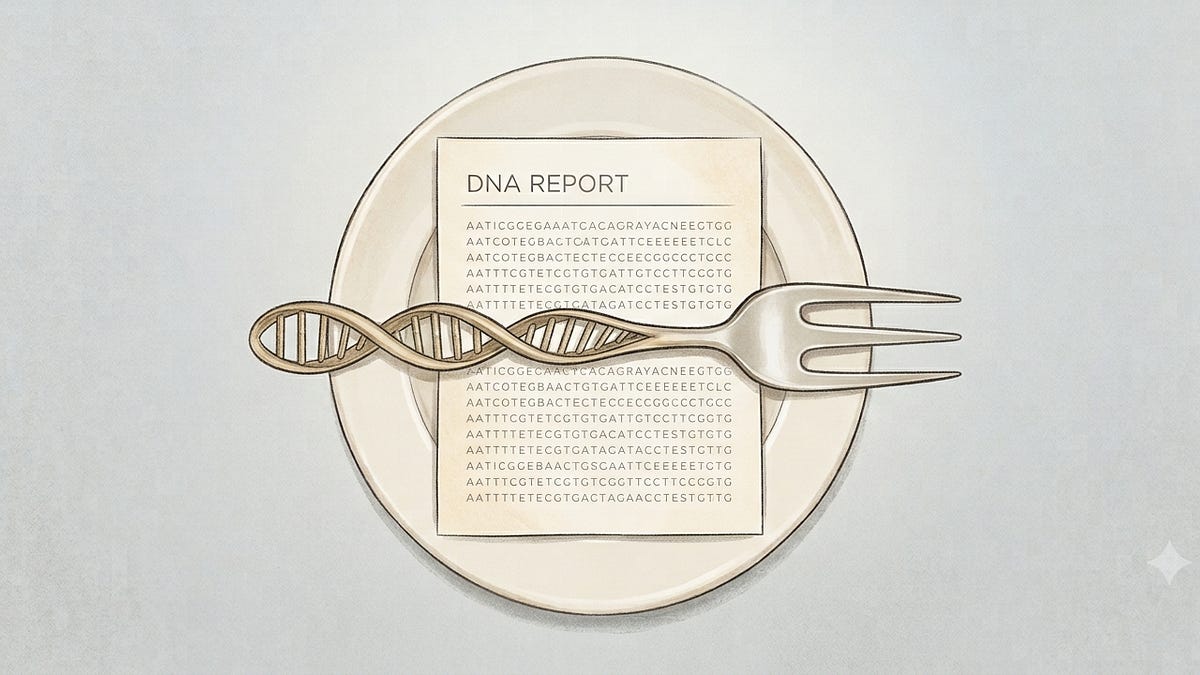
Imagine opening an envelope, or a health app notification, and learning that you carry a mutation tied to a lifetime risk of serious illness far higher than average. High enough that doctors may urge you to act before anything is wrong.
Your body feels no different, nothing hurts, and no symptom sent you looking, but the number lands hard because it is a verdict about your future delivered while you are still perfectly healthy. You picture yourself sick before you are sick, and you start making decisions for a future body that has not arrived yet. The harder questions come later.
When it sinks in that your own body may turn on you, where do you look for hope?
Some people find it in science, the belief that the body is a system and the system can be understood, monitored, and managed. Some find it in God, or spirit, or a sense of being held beyond what instruments can measure. And some hold both, like me.
Not the usual fork in the road, but a three-tined one: science, God, and both.
Bryan Johnson is a striking example of the science tine. Johnson, the entrepreneur known for spending millions of dollars a year trying to reverse his biological age, had already staked out his answer before his recent diagnosis put him back in the news this week. His answer is an extreme version of faith in measurement, optimization, and engineering. In 2025, Johnson announced Don't Die, a movement he has described in religious terms, built around the idea that death should be resisted through technology, discipline, and collective commitment. He did not look past the machine, he crowned it.
Which tine a person lands on is a choice. I notice more people around me reaching for the mix I landed on. Some of that may be confirmation bias, but some of it is not. Organized religion keeps shrinking. The Christian share of U.S. adults has fallen to about 62 percent from roughly 78 percent in 2007. But belief did not disappear. Pew finds that most Americans still say people have a soul, that reality exists beyond the natural world, and that spirituality remains a meaningful part of life.
The money points in the same direction. The global wellness economy reached $6.8 trillion in 2024. Meditation, mindfulness, breathwork, chanting, retreats, sound baths, and other practices that once sat outside mainstream medicine now sit inside a vast commercial market. People are spending more on the search, not less. They are just doing more of it outside the church.
Before my genetic result, I was not settled on any tine. Sometimes I thought I leaned one way or another, but I had not really been forced to know. The gene mutation that raises my cancer risk forced the question. And the forcing turned out, strangely, to be a gift.
I landed on the middle tine: God and science together. Science told me a number and gave me surveillance, surgeries, risk models, specialists, and choices that previous generations did not have. I am alive inside the benefits of modern medicine. I do not romanticize uncertainty. I do not think a person should meditate their way around a mammogram.
But science did not answer the whole question. It could tell me my risk, but it could not tell me how to live with probability. It could not tell me what my life meant once the future became newly visible. It could not tell me why being alive in a body now defined as future-fragile still felt somehow miraculous.
I started a daily meditation practice to manage the anxiety that came with knowing. I expected stress reduction. I found something larger: not a replacement for medicine, not an escape from biology, but a way to make the biology bearable. It also unexpectedly brought connection and joy.
A genetics course I am taking now did something similar from the opposite direction. Learning how the body actually works, how cells read instructions, repair damage, copy themselves, fail, recover, and sometimes fail catastrophically, made me less convinced that science had removed wonder from the world. It made me more convinced that wonder had been hiding inside the mechanism all along.
The point is not which tine people choose. The point is that a huge number of people are about to be brought to the fork.
Predictive genetic risk is not new, but who receives it is changing. For most people, frightening medical news used to come from something already wrong: a symptom, a mass, a marker already off. Predictive testing went largely to people who sought it out because of family history, ancestry, infertility, cancer, or some other reason that made the test feel connected to a story they already knew.
Population-scale sequencing changes that. It can hand a healthy person, with nothing visibly wrong, a number that says a serious illness sits high in their odds. It can do that on an ordinary afternoon, to someone who was not looking for a confrontation with mortality. And because genes run through families, a mutation found in one body becomes a question over parents, siblings, children, cousins, and people not yet born.
Genomics, the transformation forming behind AI, is about to change the scale by orders of magnitude. The first human genome took about thirteen years and billions of dollars to sequence, finishing in 2003. Today, reading a genome can cost a few hundred dollars and take days to a couple of weeks. UK Biobank has already released whole-genome sequencing data from half a million participants.
What reached almost no one a generation ago is on track to reach hundreds of millions, and plausibly a billion people, within a decade. Each of those people will open a report expecting medical information; some will find reassurance, some will find alarm, and some will find a variant of uncertain significance, the most modern form of "we found something, but good luck emotionally processing it."
For those who find alarm, they may think they are just receiving a health result, but the result will carry older questions inside it. What do you do when the future becomes visible, but not controllable? Where do you place hope when the machine gives you probability but not peace?
That is the God Fork: science, God, or both. A billion people may be walking toward it, thinking they are only opening a medical report.