The Influencer Variant
Previously classified as harmful. Reclassified as protective.
Lauren Berkowitz · Sep 10, 2026
There was something in my daughter's voice I had not heard before, ever about this topic. She called while I was at dinner, and it could have waited, but she could not wait the hour or so until I got home to discuss it. She sounded almost excited to share the news. "Mom" she said, "Alix Earle has the BRCA gene too."
Too, because I have a BRCA mutation. I found out through my father's ancestry test when my daughter was 8 years old. So, for half her life, she has watched me navigate preventive surgeries and doctors' appointments, and she understands that she herself has a 50 percent chance of having the mutation. The lightness in my daughter's voice, and the urgency to call me and share the news, told me that Earle sharing her result on a Netflix show resonated with my daughter and gave her some kind of hope or comfort or connection that nothing I had tried or done in 8 years had.
I posted about the call on LinkedIn. The post did almost four times the views of anything I had written this past year.
Influence
Influence, in my historical opinion, is earned as the result of something else, expertise developed, work done, judgment demonstrated, accomplishment accumulated over time. First comes the reason people should listen to you, then the influence might follow. People who were famous primarily for being famous had another name, celebrities, and celebrity influence over politics or complicated science bothered me. Social media extends celebrity further and faster. The earning now comes from understanding algorithms, building an audience, and knowing what keeps the audience watching. That reach, on its own, is both the credential and the proof of being an influencer.
Earle Meets World
Alix Earle is 25 and built her social media audience posting get-ready-with-me videos on TikTok and Instagram. She then went on Dancing with the Stars, the show that crowns social media influencers as mainstream celebrities for millennials and olders, and on September 4 debuted Earle Meets World on Netflix. In two episodes, she and her sister Ashtin, 23, are tested and learn that they carry an inherited BRCA2 variant, after their mother, Alisa, was diagnosed with breast cancer and tested positive for the same mutation. A certified genetic counselor delivers and interprets the results on camera. Neither sister has cancer. Nothing they said was new information to my daughter. The new part was Alix Earle. -A clarification, because the language is confusing - everyone has BRCA1 and BRCA2 genes. When people say someone "has BRCA," they mean a harmful inherited variant in one of those genes, which raises the risk of certain cancers.)
By September 8 the series was the third-most-watched show on Netflix in the US. BRCA cannot take credit for the ranking, Alix Earle was popular before her genetics disclosure, and her audience followed her. US Google search interest in BRCA hit its high for the month the weekend after release, roughly four times its August norm, according to Google Trends. Interest in BRCA2, the gene the sisters carry, ran 350 percent above the same period last year.
Anyone like me?
The counselor on camera matters for a subject this consequential. Angelina Jolie's 2013 New York Times op-ed explained her BRCA1 variant, her 87 percent risk, and the surgery she chose. Three weeks later, Johns Hopkins researchers surveyed 2,500 American adults. Three in four knew about the mastectomy, and fewer than one in 20 could explain what her risk meant. The explanation was in the article, and the public really only kept the headline. On the Earle show the counselor supplied the clinical meaning to the sisters as they heard the result, and Earle supplied the reason a 16-year-old might listen.
A counselor explains what a result means medically, but the first questions people ask after a result like mine are not medical: Is there anyone like me? Does anyone my age understand this? Am I sick now? What am I supposed to do with knowledge about something that has not happened? For eight years the only person my daughter could watch answer those questions was me, and I am her mother, not her peer. Alix Earle is 25, carries the same kind of result, does not have cancer, and is on Netflix, Insta and TikTok. My daughter now has an answer to the first question.
Intimacy at a distance
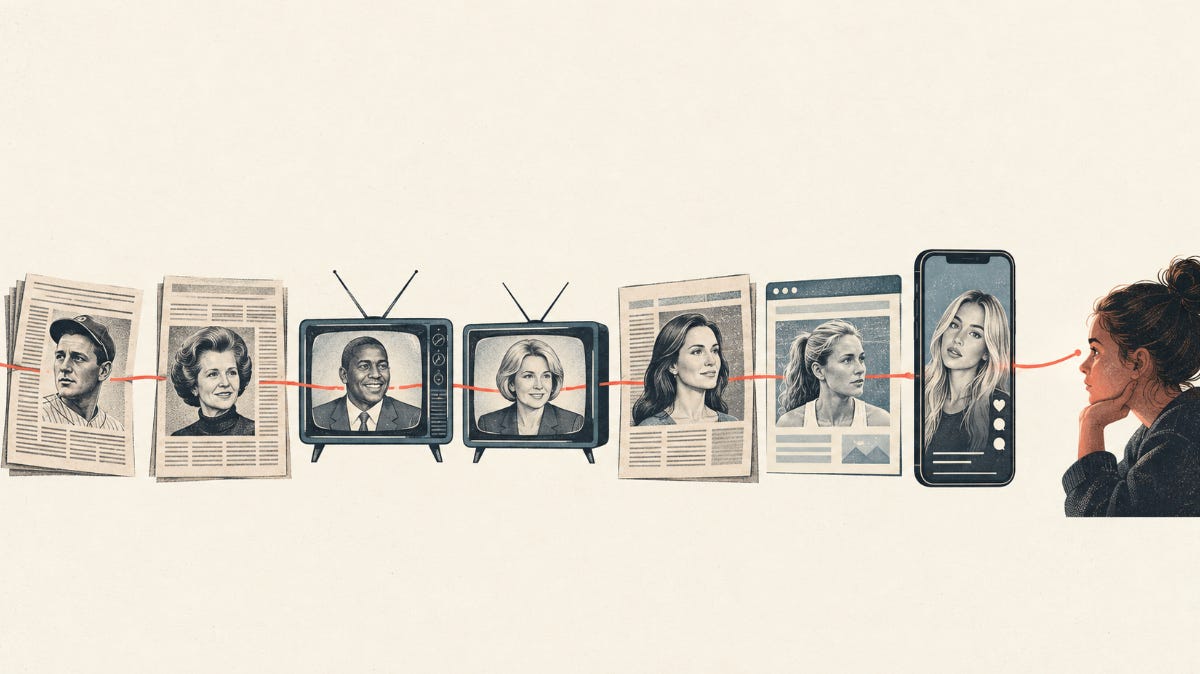
Celebrity disclosure has affected health behavior for decades because familiarity can feel like relationship. In 1956, two sociologists studying television audiences watched viewers form attachments to hosts who did not know they existed, and named the attachment parasocial interaction, intimacy at a distance. The viewer feels she knows the host, the host does not know the viewer, and the viewer acts on the feeling anyway. Two things are different on social media. First, there is no gatekeeper, a network executive used to decide who got a show and a time slot, now the audience decides. And second, the relationship is no longer one way. A follower can comment, message, and get an answer, which arguably makes the connection closer than anything a television host had with a viewer. That's one reason why brand deals with influencers work.
ALS was identified in 1869 by a French neurologist, Jean-Martin Charcot, and some of the world still calls it Charcot's disease. When Lou Gehrig was diagnosed in 1939, Americans had never heard of ALS (its more technical term) and had all heard of Gehrig, so here it became Lou Gehrig's disease and stayed that for a long time.
Betty Ford announced her mastectomy from the White House in 1974, at a time when the words breast cancer were rarely said in public. Women went for exams, and breast cancer diagnoses in the United States the following year ran about 15 percent above the year before. Angelina Jolie's 2013 op-ed did the same for a genetic test. BRCA testing among insured American women rose 64 percent in the three weeks that followed, and at the end of the year it was still running 37 percent above the rate before she wrote.
Ford and Jolie needed television time, press coverage or an opinion page for distribution. Their disclosures (and those from others including Magic Johnson and Katie Couric) moved from one large platform out to the public. Social media moves differently. A clip can be shared, answered, argued with and served directly to people whose prior behavior suggests the clip will matter to them, including people who would never have thought to search for BRCA.
ALS Challenge
In 2014 Lou Gehrig's disease changed its name back. Seventeen million Ice Bucket Challenge videos went up on Facebook that summer, watched 10 billion times, and $115 million went to the ALS Association in six weeks. The challenge also taught the country the acronym. Andrew Frates, whose brother Pete had ALS and made the challenge about the disease, said so three years later - having the disease branded ALS rather than Lou Gehrig's disease is huge, because now people can Google ALS. The name evolved the summer people poured ice water on their heads on social media.
A shift in perspective
So in less than 10 seconds of hearing something different in my daughter's voice, my perspective on influencers changed dramatically. I can remain skeptical of the social media process and incentives while appreciating that the same closeness that sells mascara turned familiarity into recognition. And for someone on the unfamiliar side of a genetic result, recognition is the difference between receiving frightening information alone and realizing that other people are already living with the same result, and feeling differently about being part of a club.
That is what I mean by the influencer variant, not a different kind of person, but a different use of influence.
My daughter knew the facts already. Still, she could not wait until I got home to call me, and I believe felt better. There is nothing better than that as a parent, so thank you to all the celebrities and influencers who have done and will do that important work.
Sources In order of appearance: Earle Meets World episode details and the genetic counselor on camera, E! News and SurvivorNet, September 4 and 5, 2026. Netflix ranking, Tom's Guide's reading of the Netflix US daily top 10 as of September 8, 2026. BRCA and BRCA2 search interest, Google Trends, United States, past 30 days, read September 9, 2026. Jolie's 87 percent risk, Angelina Jolie, "My Medical Choice," New York Times, May 14, 2013. Jolie awareness survey, Borzekowski et al., Genetics in Medicine, published online December 2013, 2,500 US adults surveyed three weeks after the May 2013 op-ed, with the Johns Hopkins Bloomberg School of Public Health release. Parasocial interaction, Horton and Wohl, Psychiatry, 1956. ALS identified in 1869 and the Gehrig naming, the ALS Association. Betty Ford and the 15 percent rise in diagnoses, the Cancer History Project. BRCA testing after the Jolie op-ed, 64 percent in 15 business days and 37 percent above baseline at year end, Desai and Jena, BMJ, December 2016, insurance records of about 9.5 million women. Ice Bucket Challenge videos and views, Facebook's count for June 1 to September 1, 2014, via Adweek; the $115 million, the ALS Association. Andrew Frates on the name, Baseball Hall of Fame ALS Awareness Weekend, 2017.