The Letter C
The seventh-grade sign language cheating ring that got me to a Harvard genetics exam.
Lauren Berkowitz · Jul 21, 2026
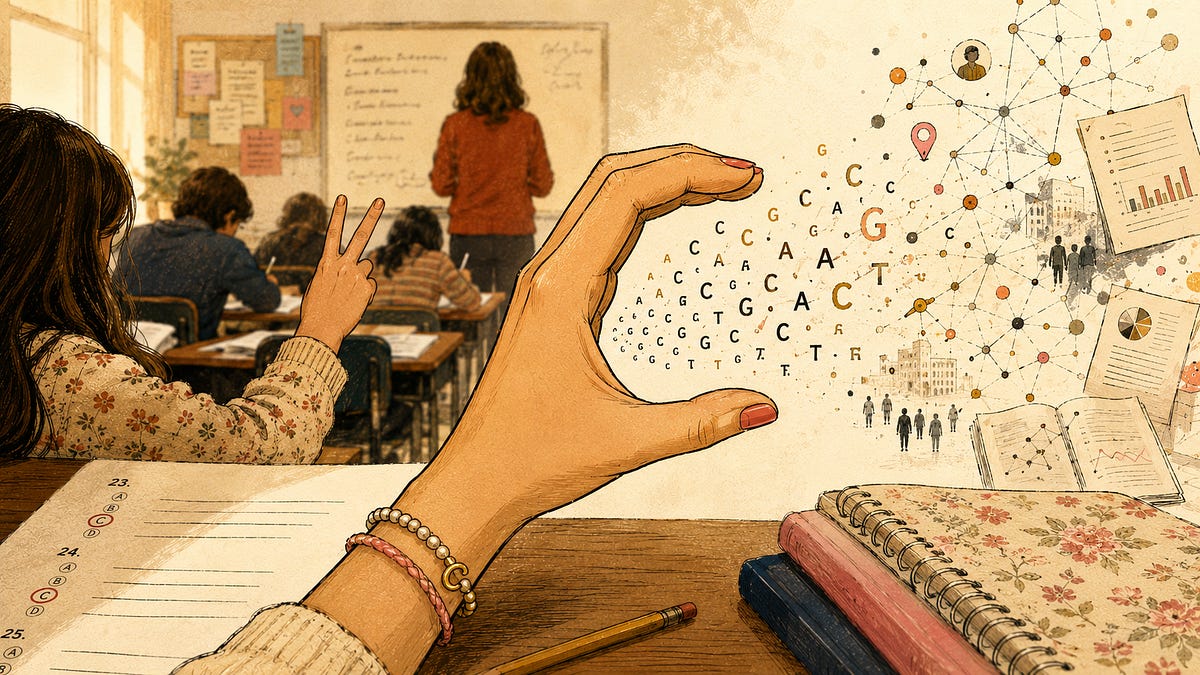
In the American Sign Language alphabet, the letter C is exactly what it looks like, a hand curved into a half circle, held sideways, as if gripping a jar. It is one of the easiest letters to learn and to read across a classroom, which mattered, because in seventh grade I spent a fair amount of test time signaling it from the edge of my desk. Somewhere across the room a hand would flash the number of a question, two fingers and then three for twenty-three, and my hand would curve into the answer: C.
Two things happened this weekend that sent me back to that classroom. I passed the final exam for a genetics certificate program at Harvard Medical School, and a project I have been building with Dave Ferrucci, the AI scientist who led the team that built IBM's Watson, was accepted for a poster session at Weill Cornell's hereditary cancer symposium in October. The project maps the organizations and relationships of that world to help fast-track discoveries and improve patient outcomes. Two milestones landed in one week. My actual degrees are in law and business, and people sometimes ask how I keep ending up in fields I have no credential for. The honest answer starts in seventh grade, with a hand making the letter C. It is the closest thing I have to an origin story.
The story actually starts a year before that classroom, in Lake Hopatcong, New Jersey, where by every measure available to a twelve-year-old, I was winning. We had lived there since I was three or four, and I had no memory of anywhere else. The house was up the street from the biggest lake in New Jersey, I had a pack of friends I played outside with until dark, and in fifth grade the school gave me its best student award. Then in April of sixth grade, my dad came home and announced we were moving to Fort Washington, outside Philadelphia, for his job. For reasons I still don't understand, we could not wait the two months until the school year ended in June, and we moved in April.
What followed was the worst year of my childhood, in a new school with no friends and no lake. I cried every day, from April through June, all summer long, and into the fall. Somewhere in there I also developed a nervous stutter.
At some point in seventh grade the crying stopped being cathartic and started being boring, and I decided to treat my situation as a problem instead of a fate. An inventory of my assets came up with one entry: answers. Tests were about the only part of my life still working, and the popular kids, I noticed, struggled with them, so a trade was available. They had friends, which was the thing I wanted most, and I had answers, which was the thing they needed. The only obstacle was that the exchange had to happen silently, in a room supervised by an adult whose entire job was preventing it.
The solution was sign language. I cannot say where the idea came from for sure, though a Helen Keller movie, The Miracle Worker, had aired on TV, and the way words got spelled into her palm possibly stuck. I taught myself the alphabet, and Betsy, one of the few popular girls who actually talked to me, learned it with me. And, through her, the testing aid reached the kids who needed it. They signed the question number to me, and I signed back the answer, A through D for multiple choice, or spelled out letter by letter when a blank needed a whole word. It worked, and pretty quickly, as I could serve several people at a time. Their grades went up, my social life materialized, and with the popular kids, no less. I was back, baby!
To be clear about the ethics of the operation, I did not feel like I was cheating, because I was not taking answers, I was supplying them. At least that is what I told myself, and whether the distinction would have impressed the teacher is a question that fortunately never got tested. It never got tested because the operation ran on a second skill, reading a room. I always knew where the teacher's attention was, when it was safe to signal, and when to lay my hand flat on the desk and wait. Book smarts got me the answers, and reading the room got them across it.
What mattered more was what the scheme taught me. Before that year, studying had never touched my actual life. I studied, I took the test, a grade came back, and that was the end of it. This was different. I learned something on purpose, used it in the world, and my life got better because of it. I had friends again, and I felt like a person again. Years later I would hear the concept called applied learning. In seventh grade it felt like discovering that school had a secret function nobody had mentioned, you could learn your way out of a situation you hated. There is a moment, if you are lucky enough to get it, when you stop asking what will be on the test and understand what the learning is for. That was mine.
That discovery set the direction of my life. When the music business hit its first digital pivot, I was a young lawyer who took the time to understand the new technology, and understanding it got me to the table for the industry's early digital deals. When AI became commercially real, I learned that too, first at IBM during Watson's defining years, then as chief of staff to Dave's research group, which we spun out of Bridgewater into its own company. In every one of those fields I arrived without the credential and learned my way to the seat.
Then my own DNA results arrived. I carry a BRCA1 mutation, which raises my lifetime risk of certain cancers far above average. The letter C had found me after all, though not in the way that sentence usually goes. I do not have cancer. I have a predisposition, which means I live with information instead of illness, a risk that shows up decades before any diagnosis might, screening built on probabilities rather than symptoms, and decisions about things that have not happened yet. Nobody hands you a curriculum for that. Millions of people are getting results like mine now, and most of them are exactly where I was, staring at a language they were never taught. So I am doing the seventh-grade thing again and learning the language.
That is what this weekend actually was. The Harvard course was me back at the desk, a student again, working through an alphabet that runs three billion letters instead of twenty-six. The technology we built is the map I wish someone had handed me when my results came back. I am nowhere near fluent, and I am not sure anyone is yet. But I have done this before, and I know how it goes: I sit down, I learn the alphabet, and my life starts to move. It has been moving since seventh grade, when a hand first curved into the letter C.