The Longevity Superhighway Is Finally Open
The merging of wellness, aging medicine, and precision genomics.
Lauren Berkowitz · Jun 3, 2026
For most of the last decade, longevity looked a lot like things we already knew, dressed up in new language. Sleep, movement, time-restricted eating, stress reduction, whole foods, the science behind all of it is real and most of it is centuries old. What changed was the measurement layer: biological age scores, epigenetic clocks, continuous glucose monitors, and a new vocabulary for tracking what your body was doing at a cellular level. People who optimized systematically did look noticeably different than they had a decade earlier, and the results were real enough that the rest of the world paid attention. But the headline claims kept arriving without the underlying science to make them universally true, and most people watching from the outside thought the same thing, of course you look better and live longer if you can afford to eat well, sleep properly, move every day, and eliminate stress from your schedule. That is not a revolution, that is just a very good life, for people with enough money and flexibility to construct one.
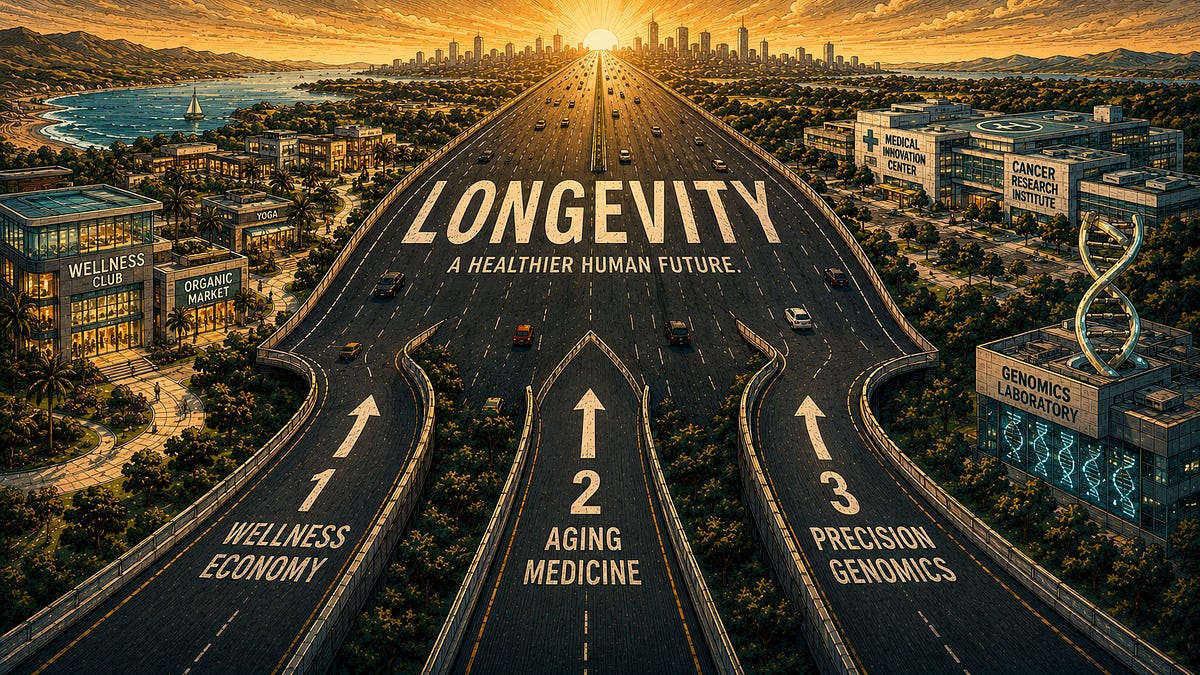
It is arriving now. Not because anyone declared it open, but because three separate roads finally built enough infrastructure to merge, and they are not arriving as equals.
The first road is the wellness economy, and it is genuinely large and increasingly grounded. The global wellness market is projected to reach $8.5 trillion by 2027, and the Global Wellness Summit said this year the market has been rewritten more in the last two years than in the previous twenty. The field is visibly moving away from superhuman aspirations toward biology that has actually been tested. It got to the highway first and built the loudest on-ramp. But it is not the destination. The second road is aging medicine, and it just produced results that would have seemed implausible five years ago. At ASCO 2026 last week, Revolution Medicines presented data on daraxonrasib, a targeted daily pill for pancreatic cancer whose underlying KRAS mutation was considered undruggable for decades, showing practice-changing survival improvements over standard chemotherapy. The FDA approved Datroway as the first antibody-drug conjugate for first-line triple-negative breast cancer, where previously only chemotherapy existed as an initial option. Eli Lilly reported a 62 percent reduction in cholesterol from a gene-editing therapy in early trial data. The diseases of aging are not holding the line they held a generation ago.
The third road is precision genomics, and it is the one that changes what the other two mean.
Researchers at the Targeting Longevity 2026 congress in Berlin this spring made the shift explicit: the field is moving away from searching for a single anti-aging intervention and toward a systems question, asking whether aging itself is a progressive loss of coordination between biological systems. The biological pathways that drive hereditary cancer risk, DNA repair, genome stability, cellular senescence, are the same pathways aging medicine is now targeting with its largest capital commitments. The same AI operating across Tempus's 7.3 million patient records and the UK Biobank's 500,000 whole genomes is finding connections between cancer, Alzheimer's, cardiovascular disease, and metabolic dysfunction that the siloed institutions treating them separately have not systematically mapped. The cost of running that reasoning at institutional scale has dropped roughly two orders of magnitude per year since 2024. The data and the compute to make sense of it are arriving at the same time, and what they are making possible is something the wellness economy and aging medicine cannot provide on their own: a reasoning layer that can tell a specific person what their biology means and what to do next.
That population is larger than the longevity industry has been designed to serve. A Mayo Clinic study published this year estimated that roughly one in eight seemingly healthy adults carries a medically actionable genetic finding they do not know about, and a 2025 JAMA study found roughly one in twenty U.S. adults carries a pathogenic germline variant in a cancer susceptibility gene alone, before cardiovascular, neurological, and pharmacogenomic categories are added. The missing infrastructure is not another test, protocol, or supplement. It is the layer that connects what the genome says to what a person should actually do, delivered at a scale and cost that does not require a concierge medicine budget to access.
Thomas Clozel, the oncologist and co-founder of Owkin, put the stakes plainly earlier this year: 99 percent of the longevity space is noise, and the signal is already in front of us. Not dying before 65 counts.
Targeted cancer therapies do that. Knowing your variant, catching it early, and intervening precisely is the highest-yield longevity strategy available to this generation. Alex Zhavoronkov, founder of Insilico Medicine and a committed longevity optimist, asked eight frontier AI models how much drugs can actually extend human life and called the numbers sobering. Two people with different priors arriving at the same conclusion is worth noting.
Israel understood this earlier than most. After Ephrat Levy-Lahad established that BRCA cancer risk is elevated in carriers identified from the general population, not just those with a documented family history, Israel launched a nationwide free BRCA screening program reaching more than 60,000 women annually. Between 2020 and 2025, Asia launched 22 new genomic initiatives while North America launched five. The people who have solved the data coordination problem are the ultra-wealthy, through concierge medicine and executive health programs, whose solution is a dedicated human curator holding a coherent picture of one person's biological signals across every system and every reclassification. It works. It does not scale by design.
The superhighway is open, and the three lanes are merging faster than the ground underneath them can support. Nobody predicted they would all converge at the same moment AI started replacing the underlying infrastructure. The wellness economy got there first and built the loudest on-ramp, aging medicine is now delivering results that were theoretical five years ago, and precision genomics is the lane that connects your specific biology to both of them, the one most people have not yet been told they can access. Whatever that number becomes, and it will keep growing, the more useful question is a personal one: which lane are you actually on, and how far back are you in the merge.