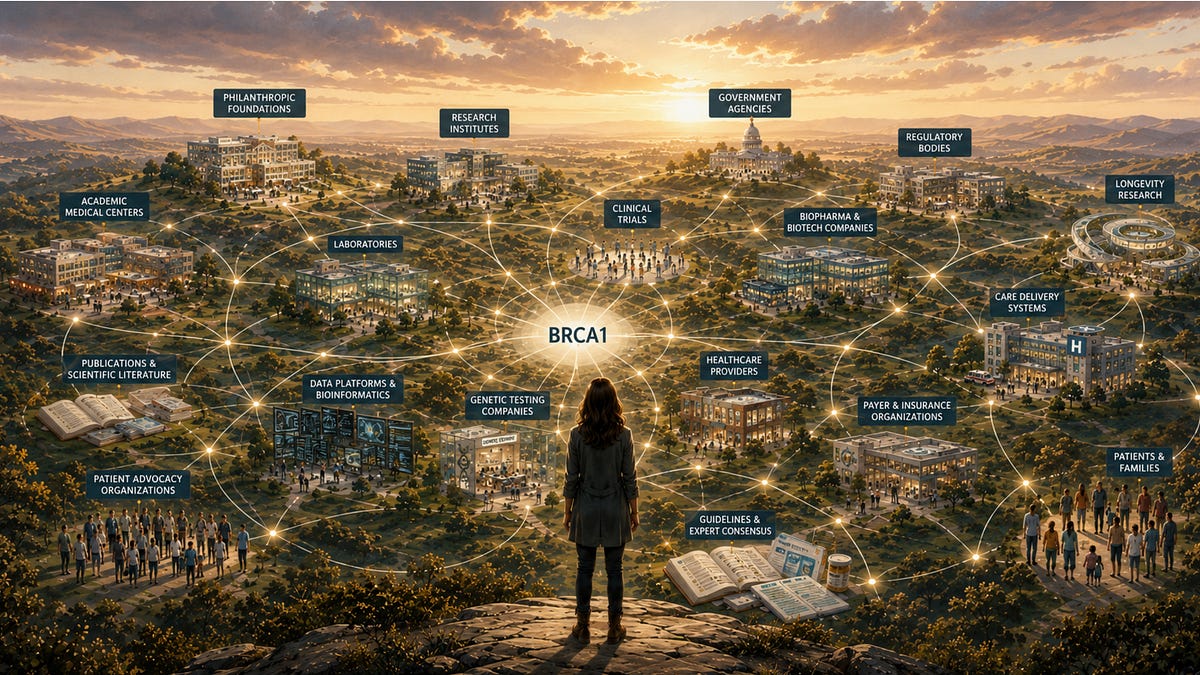
Zoom in on a map and you get a close-up of what you were already looking for. The street, the door, which way to turn at the corner. Pull back and it becomes something else. Now you can see where you are, which roads connect, which never meet, and which places you can only reach by passing through somewhere else first. The close-up tells you how to move. The wide view tells you what exists.
Most fields have both. You can study one company or the whole market, one battle or the whole war. Genomics has become very good at the close-up and has almost no wide view. Everything about a genetic mutation is searchable. How it all fits together is not. And the newer tools, the ones that answer in sentences instead of links, rarely return the same answer twice, so the ground you searched yesterday is not there today.
Not for lack of material. In 2000 the number of genes tied to a disease passed a thousand. OMIM, the reference catalog of human genes and conditions, now counts 5,083 genes and 7,742 conditions with a known molecular cause. The trajectory is in OMIM's own growth chart.
The trouble is that every place you look is built to answer one kind of question. Ask ClinVar, the public database clinicians and labs lean on most, about a single variant, and it does something hard very well -whether the variant has been classified pathogenic, by whom, and on what evidence. What it cannot tell you is anything about the world around the variant - the lab that found it, the foundation that funded the lab, the trial down the hall, the families waiting on all of it. None are in the frame, because the frame is the variant.
That is not a flaw. It is a choice, and every major source of intelligence in genomics makes the same one. Publications organize around papers, trials around trials, variant databases around variants, market intelligence around companies, registries around patients. Each is excellent at its own question. I kept assuming I had not found the right database yet. There was none to find. No system is organized around the thing I was standing inside, the whole ecosystem that had grown up around one gene.
The reason is simple. Medicine was built around disease. Something goes wrong, you find out, and the job is focus. There is a thing to treat, and the only questions are how fast and how well. A close-up is exactly right for that.
Predictive genomics changes the starting point. You can find out decades before anything is wrong, which means you are not treating anything. You are choosing. Disease organized medicine around what has happened. Predictive genomics organizes it around what might. A person in that position is not deciding how to treat a disease. A person in that position is deciding how to live with probability, and a close-up was never built for that.
So I started with a spreadsheet. Researchers in one column, then the laboratories, the testing companies, the patient organizations, the pharmaceutical companies, the hospitals, the foundations, the regulators, the payers, the guidelines, and the trials. That helped, but I wanted the relationships. When you are technically fine and weighing life-altering medication and organ removal, you want to know how things connect, how well funded they are, how senior the researcher is. A list tells you who exists. Relationships tell you how a field works.
The first thing the wider view showed me was not how little was happening. It was how much. Thousands of researchers, hundreds of organizations, on several continents, all working different pieces of the same gene, none of them visible from inside a single search.
What a list cannot show, and relationships can, is dependency. A dependency does not appear one search at a time. In 2024 Invitae, once one of the largest hereditary cancer testing laboratories in the country, filed for bankruptcy, and Labcorp bought its assets out of the auction for about 240 million dollars. Anyone whose test, variant reclassification, or research sample had run through Invitae woke up depending on a different company, most with no reason to know the dependency was there until it moved. Concentration risk is the ordinary name for it, and no view built around one kind of thing at a time will show it to you.
That is what the wider view is for. It holds the money, the science, the testing, the care, and the dependencies between them in a single frame, where a foundation deciding what to fund or a program deciding what to build can see what has to still be standing in four years. That is the difference between a directory and a decision.
The people who understood the map first were not other patients. They were researchers and nonprofit leaders, because a nonprofit can finally see where it sits in the whole, and show a partner how much of the field depends on the organization. I made the map for myself and expected that to be the end of it. I am now working with FORCE, a leading hereditary cancer nonprofit, and presenting the work at Weill Cornell's hereditary cancer symposium in October.
I still zoom in. I read the papers on my own variant like anyone would. What is different is that I can pull back now. The mutation did not change. The uncertainty did not change. What changed is that I can finally see where I am, and that the field I landed in is far larger and far more connected than any single search would have shown me.